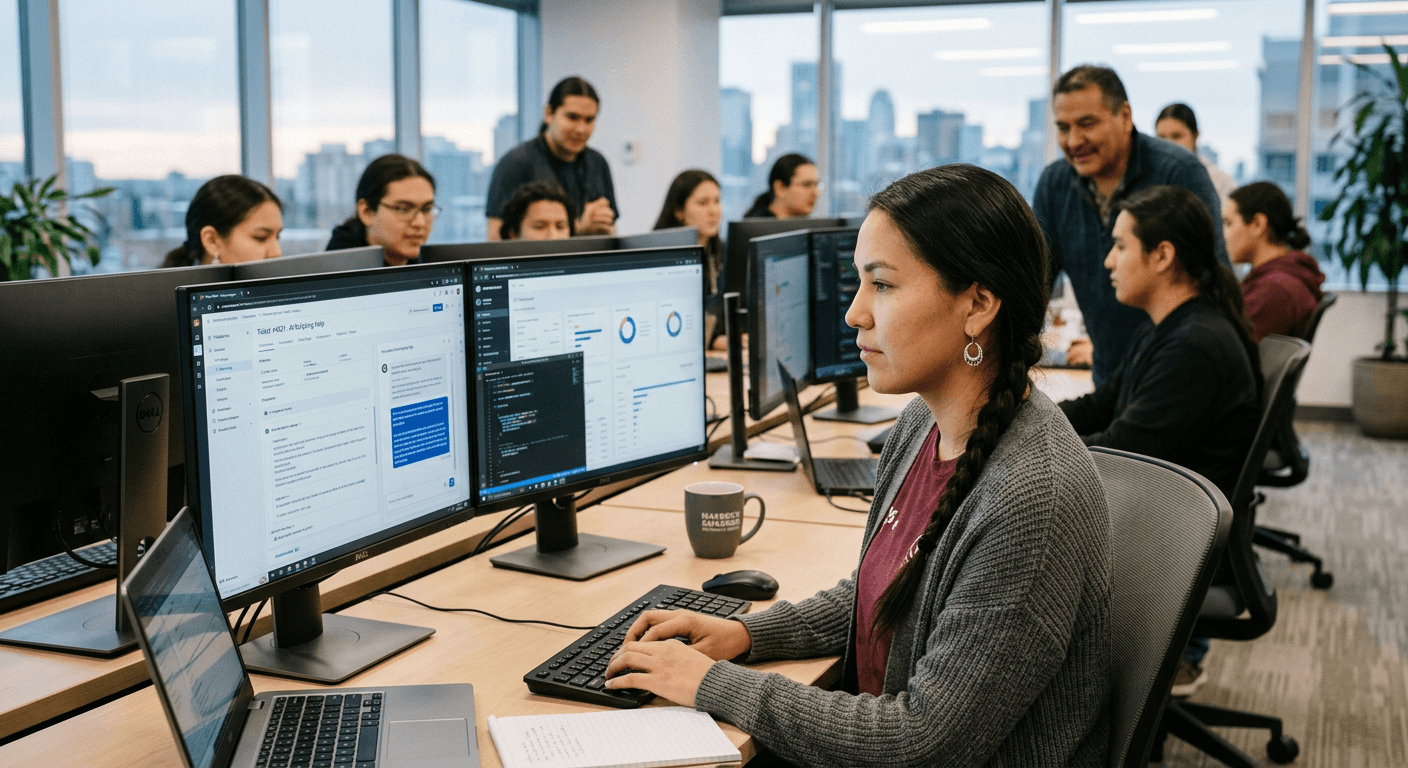
Artificial intelligence is rewriting the bottom rungs of the tech career ladder. The question for Indigenous workforce development is not whether AI will reshape entry-level tech work — it already has. The question is whether the next generation of Indigenous tech workers will ride that wave or get left behind by it.
At Maverick Gardner Pathways North, we have spent the last year watching AI move from a curiosity to a daily tool in the kinds of jobs our participants are training for: IT helpdesk, network operations, security operations, and compliance support. We have also watched the conversation about AI and employment swing between two unhelpful extremes — “AI will replace everyone” on one end, and “nothing has really changed” on the other. Both are wrong. What is actually happening is more interesting and more demanding.
What AI is actually changing at entry level
Five years ago, an entry-level IT support job was built around a steady volume of routine tickets: password resets, account lockouts, software installs, simple how-tos. Those tickets are now being absorbed by AI chatbots and self-service portals. The work that remains for human Tier 1 support is the more complex, judgment-heavy, conversation-heavy work — the calls where the customer is frustrated, the issue is ambiguous, and the right answer is not in a knowledge base article.
The same shift is happening across the entry-level stack. In Security Operations Centres, AI is triaging alert floods that used to consume an analyst’s entire shift, freeing humans to investigate the alerts that actually matter. In documentation work, AI is drafting first-pass knowledge base articles and incident summaries that a human reviews and finalizes. In development and scripting, AI assistants are accelerating junior output to the point where a well-equipped first-year IT worker can produce code and automations that used to require three or four years of experience.
The net effect is not fewer entry-level jobs. The net effect is a different kind of entry-level job — one that demands stronger judgment, faster learning, clearer communication, and the ability to work alongside AI tools rather than around them.
The opportunity
For Indigenous learners, this shift contains a real opportunity that should not be overlooked. AI tooling is the most powerful force multiplier the workplace has seen in a generation. A junior worker who is fluent in AI tools can produce more, learn faster, and contribute at a higher level earlier than was ever possible before. Some of the barriers that have historically held back learners without traditional credentials — documentation polish, professional writing, technical research speed — are exactly the barriers AI is best at helping with.
Remote work, combined with AI tooling, also opens doors that were previously closed by geography. A skilled IT worker living in a small Manitoba community no longer needs to relocate to Toronto or Calgary to access serious tech career opportunities. With reliable broadband and the right skills, the work is genuinely portable in a way it was not even a few years ago.
Used well, AI is not a competitor for entry-level workers. It is a teammate that makes them better at their jobs faster.
The risk
The opposite is also true. If access to AI tools, AI training, broadband, and AI-fluent mentorship is unevenly distributed, the gap that already exists in Canadian tech will not just persist — it will compound. The Indigenous Peoples who currently make up only about 1% of Canada’s tech workforce are not going to close that gap by being trained for jobs that no longer exist in the form they once did.
Workforce programs that treat AI as an optional add-on, or as something to address “once the basics are covered,” are training people for yesterday’s job market. The basics have changed. AI literacy is no longer a senior skill or a specialist skill. It is a baseline competency for entry-level tech work in 2026, and any program that ignores that reality is putting its participants at a disadvantage from day one.
What we are doing about it
Our approach at MGPN is straightforward. AI literacy is built into the curriculum from the first week, not appended as a bonus module at the end. Participants learn to use the same AI tools that are actually deployed in MSP environments — for ticket summaries, documentation, scripting, knowledge base authoring, and learning support. They learn what AI is good at, what it is bad at, when to trust it, and when to escalate past it.
Just as importantly, we emphasize the skills that AI is genuinely bad at and that any tech workplace still desperately needs client-facing communication, judgment under pressure, accountability for outcomes, ethical handling of sensitive data, and the integrity to flag something rather than paper over it. Those are the skills that decide whether someone moves from a Tier 1 role into a Tier 2 role, and from a Tier 2 role into senior work. They are also, not coincidentally, the qualities we screen for at intake — inquisitiveness and integrity over technical credentials.
The bet we are making is that Indigenous tech workers who are AI-fluent from day one will not be catching up to the curve. They will be on it.
Where we go from here
The hardest part of any technology shift is not the technology itself. It is making sure the right people are positioned to benefit from it. The history of every major economic transition — industrial, digital, and now AI — is a history of communities that got the new tools early and communities that did not, and the gaps that resulted lasted generations.
The AI shift is happening on a much faster timeline than any of those previous transitions. Programs designed for last year’s labour market are already out of date. The window to make sure Indigenous learners are part of the next generation of AI-fluent tech workers is narrow, and it is open right now.
If you are a learner curious about what AI changes for a tech career, or an employer wanting to build a team that reflects Canada and uses AI tools fluently, we would love to talk. The opportunity is real, and so is the risk of missing it. The difference between the two is choice — about who gets the tools, who gets the training, and who gets the seat at the table when the next decade of Canadian tech is built.