How MGPN's employer-first model is different — and why it matters
Most workforce training programs run on simulations. Practice labs. Sandbox environments. Hypothetical case studies built from scratch by an instructor who knows what is supposed to happen at every step. Participants work through tickets that never reach a real customer, troubleshoot networks that no one relies on, and document fixes that nobody outside the classroom will ever read.
There is nothing wrong with that model. It is the standard for a reason — it is safe, it is repeatable, and it is easier to control. But it has a quiet problem at the centre of it: when you only ever work on fake problems, you are only ever practising how it feels to work.
At Maverick Gardner Pathways North, we have built our program around a different idea. The work is real from day one.
What “real work” means here
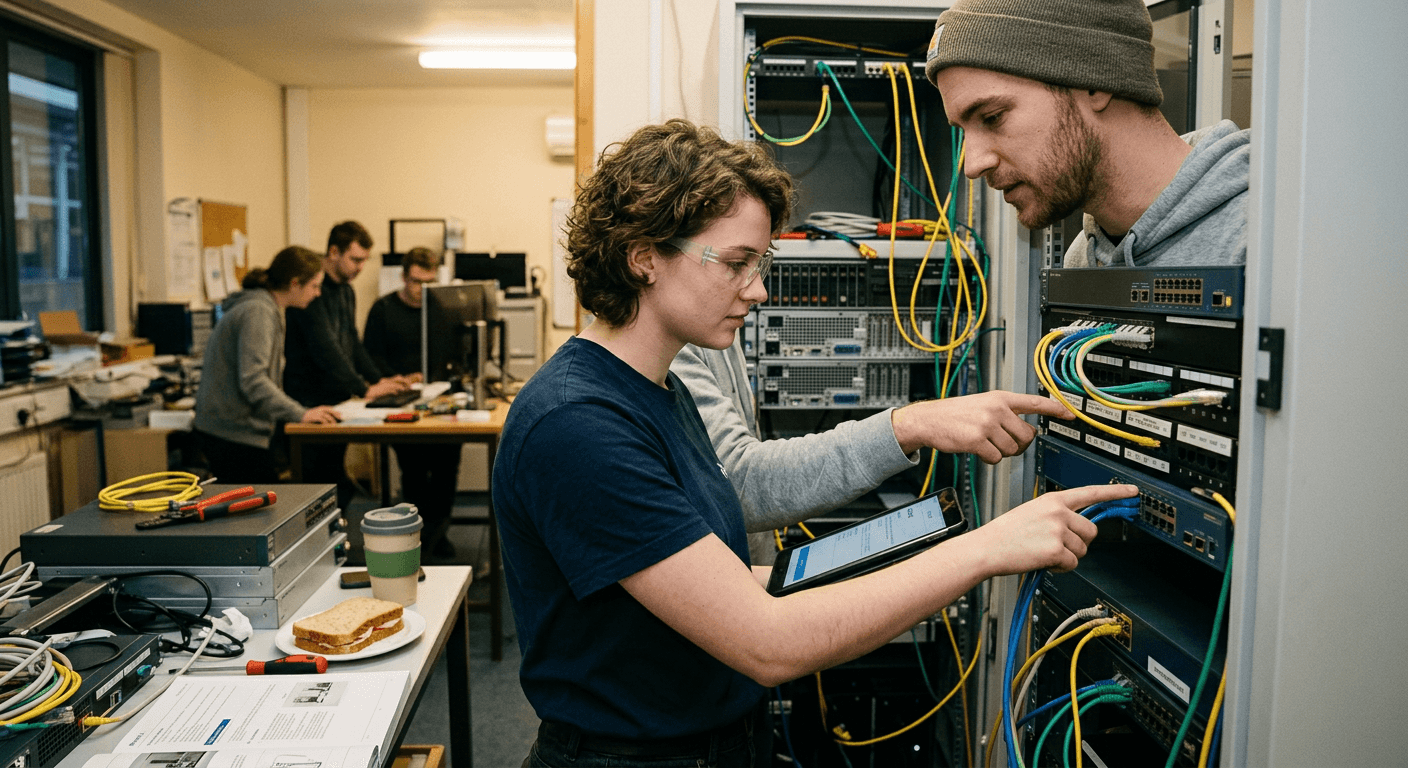
MGPN participants do not spend months in a simulated lab before they touch a live ticket. From early in the cohort, they work alongside our senior IT staff on actual client services — the same managed service provider work that pays the company's bills. Real tickets from real businesses. Real documentation that real people will use. Real time tracking, real client communication, real consequences if something is missed.
That work is supervised. Participants are not thrown into deep water — they are paired with senior staff, the tasks they are assigned are scoped to their skill level, and every deliverable is reviewed before it goes to a client. But the work itself is not pretend. The customers are not pretend. And the standards are the same standards that apply to any other MGPN employee.
Why this matters for participants
The first thing real work changes is what learning feels like. A simulated ticket teaches you the steps to resolve an issue. A real ticket teaches you the steps to resolve an issue while a frustrated customer is waiting, while three other tickets are open, while documentation has to be written for the next person on shift, and while the clock is ticking on a service-level agreement. Those constraints are not noise. They are the job.
Real work also produces a real portfolio. When an MGPN participant finishes a cohort, they leave with documented experience on live systems — tickets they closed, documentation they wrote, incidents they helped resolve. That is not the same thing as a stack of training certificates. Certificates open doors. Real experience walks through them.
And because our model is structured around wage activation — the transition from training to paid work happens within the program — participants earn actual income as soon as they are ready to deliver client work. That changes the financial math of training. Most workforce programs leave participants juggling tuition, living costs, and lost income for months. Ours does not.
Why this matters for employers
When an employer hires from a simulation-based program, they are taking on someone who has demonstrated potential. When an employer hires from MGPN, they are taking on someone who has already done the work. There is no learning curve about what a real ticket looks like, what a real client expects, or what real documentation discipline requires. That curve was climbed during training.
This matters more than it sounds. The number one reason junior tech hires fail in their first ninety days is not technical skill — it is the gap between simulated learning and the actual rhythms of professional work. Removing that gap is the single largest predictor of retention in entry-level IT, and it is the gap our model closes by design.
The harder parts
This approach is not easier. Real work requires real accountability, real time tracking, real client communication standards, and real consequences when something is missed. Participants in our program are held to the same documentation and quality bars that any senior staff member would be — because the documentation they produce is going to a real client, and any sloppiness shows up in that client's experience.
Not everyone wants that. Some learners genuinely prefer the lower-stakes environment of a simulated lab, and that is a legitimate choice. But for participants who want to know what the work actually feels like — and who want their training to count as real experience from day one — the model we have built is uncommon, and we think it is worth talking about.
Where the money comes from
One quiet benefit of real-work-based training is that it generates revenue. Client work is billable. The income from those services helps fund the training program. That structure is not just financial housekeeping — it changes how the program survives over time. A workforce program that depends entirely on grants is one funder decision away from shutting down. A workforce program that pays its own way is sustainable in a way that grant-funded programs structurally cannot be.
That sustainability matters for the long-term promise we make to participants and partners. We are not running a pilot. We are running a business that trains people.
Where we go from here
Real work, supervised carefully, is what produces real outcomes. That is the bet we are making, and the early signs from our first cohort suggest the bet is paying off in ways that simulated training cannot match — in confidence, in employability, and in the speed at which participants move from training to paid work.
If you are a learner thinking about which workforce program to apply to, ask whether the training is built on real customer work or simulated exercises. The answer will tell you a lot. If you are an employer thinking about hiring from a workforce program, ask the same question of the program you are evaluating. The answer will tell you a lot there too.
If you want to learn more about how our model works in practice, we would love to talk.