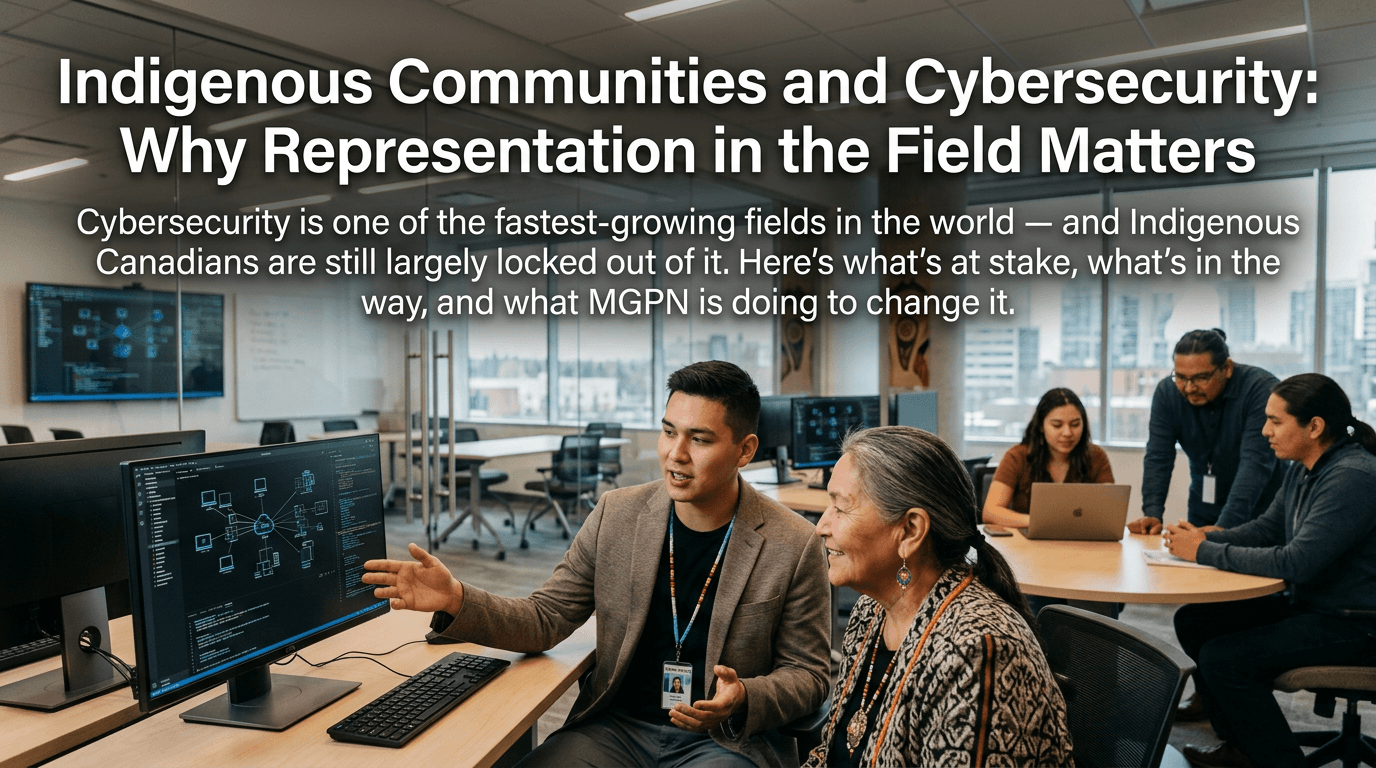
Cybersecurity is one of the fastest-growing fields in the world. Demand for
skilled professionals is outpacing supply in almost every region, and that gap
is only widening. In Canada alone, tens of thousands of cybersecurity roles go
unfilled each year — not because the work is not there, but because the
pipeline of trained talent cannot keep up.
And yet, Indigenous Canadians — who make up close to 5% of the
population — remain dramatically underrepresented in the field. That is not a
coincidence. It is the result of compounding barriers: limited access to tech
education in northern and remote communities, underfunded schools, systemic
exclusion from the professional networks where careers get built, and a
technology sector that has historically done very little to change any of it.
MGPN exists, in part, to change that. Here is why it matters —
and what representation in cybersecurity looks like in practice.
The Gap No One Is Talking About
The cybersecurity workforce shortage gets a lot of attention.
What gets far less attention is who is missing from that workforce.
Indigenous professionals are underrepresented not just in
cybersecurity but across the technology sector. A 2022 ICTC (Information and
Communications Technology Council) report on Indigenous leadership in the
digital economy found that Indigenous workers are significantly less likely
than non-Indigenous workers to be employed in high-skill digital roles — not
because of a lack of ability or ambition, but because the structural conditions
that make those careers accessible are not equally available.
Broadband access in remote and northern communities is still
inconsistent. Computer science and IT programs in many First Nations and Métis
communities are underfunded or nonexistent. The cultural gatekeeping of
professional spaces — the unpaid internships, the credential requirements that
favour certain educational paths, the networking culture that favours people
who already know people — systematically disadvantages people who are outside
those networks to begin with.
The gap is real. It is documented. And it is fixable.
Why Cybersecurity Specifically
Of all the pathways into tech, cybersecurity is one of the
most important to open up — for a few specific reasons.
First, the demand is urgent and sustained. This is not a niche
skill that will be automated away. It is a foundational function of every
organization that touches a network, processes data, or operates online — which
is essentially every organization. Governments, hospitals, schools, banks,
utilities, community organizations. All of them need people who understand how
to protect systems and respond when things go wrong.
Second, cybersecurity is one of the few high-demand tech
fields where a four-year university degree is not required to enter at a
competitive level. Certifications like CompTIA Security+, the Google
Cybersecurity Certificate, and hands-on experience in a real IT environment can
open doors that used to require years of formal education. That matters
enormously for people who cannot take four years out of their lives and
communities to pursue a traditional degree path.
Third, Indigenous communities are increasingly the targets of
cyberattacks — ransomware against band offices, phishing attacks on community
health organizations, data breaches affecting community members. Having
Indigenous cybersecurity professionals who understand both the technical
landscape and the community context is not just good workforce policy. It is a
direct community safety issue.
What Representation Actually Changes
Representation in cybersecurity is not just about fairness,
though it is absolutely about that. It is also about the quality and relevance
of the work that gets done.
Cybersecurity systems protect data — and data reflects the
assumptions and blind spots of the people who built those systems. When
Indigenous communities are not part of the conversation about how data is
collected, stored, and protected, the result is systems that do not account for
Indigenous data sovereignty, that expose sensitive cultural and personal
information to outside actors, or that replicate the extractive data practices
that communities have been fighting against for decades.
Indigenous cybersecurity professionals bring a perspective
that cannot be hired in from elsewhere. They understand what is at stake when
community data is compromised. They can advocate for Indigenous data governance
frameworks — like the OCAP principles (Ownership, Control, Access, and
Possession) — inside organizations that have never heard of them. They can
build trust between technical teams and Indigenous communities that is
otherwise very hard to establish.
That is the practical case for representation. It makes the
work better.
The Barriers Are Real — and Solvable
It is worth being specific about what gets in the way, because
vague acknowledgment of “barriers” does not actually help anyone.
The barriers Indigenous participants most commonly face when
trying to enter cybersecurity include: lack of prior exposure to tech
environments growing up, limited access to internet infrastructure for hands-on
lab practice, financial pressure to be earning income rather than training,
geographic isolation from in-person programs, and cultural environments in tech
workplaces that feel unwelcoming or exclusionary.
None of these are insurmountable. But they require programs to
be designed around the people they are trying to serve, not the other way
around. That means training that is delivered remotely where necessary, that
accounts for the costs participants carry (childcare, transportation, lost
income), that builds in cultural safety, and that leads to employment with
employers who have been vetted for their actual commitment to inclusive
workplaces — not just their diversity statement.
What MGPN Is Doing About It
The Maverick Gardner Pathways North model is built
specifically for this context.
Participants in MGPN's cybersecurity and IT pathways are not
sitting through lectures about hypothetical networks. They are doing real work
— monitoring real systems, responding to real alerts, building the kind of
hands-on experience that employers actually look for. That approach matters
especially for people entering a field without traditional credentials, because
it produces a portfolio of real experience rather than a certificate that sits
on its own.
MGPN works with employer partners who have committed to doing
more than post a job listing. They are involved in the training process, they
understand the candidates coming through the program, and they have made
concrete commitments to inclusive hiring and retention — not as a favour, but
because they have seen the results and understand the value.
The goal is not just to place participants in their first job.
It is to put them on a trajectory in a field where the career ceiling is
genuinely high and the demand is not going away.
Why This Matters Beyond the Job
A career in cybersecurity changes more than an individual's
income. It changes what is possible for a family, for a community, and over
time for an entire sector.
When Indigenous professionals build careers in cybersecurity,
they become the mentors, the managers, the advocates, and eventually the
founders and decision-makers who change how the field works for the next
generation. Representation compounds. The absence of representation also
compounds — which is why the gap has persisted for as long as it has.
Truth and Reconciliation Call to Action 92 asks the corporate
sector to ensure equitable access to jobs, training, and educational
opportunities for Indigenous people. Cybersecurity is not a symbolic field to open.
It is one of the most strategically important fields in the modern economy.
Opening it up to Indigenous talent is both a reconciliation commitment and a
practical investment in the digital economy Canada needs.
MGPN is doing this work because it needs to be done — and
because the people we work with are ready to do it, given the right conditions
to succeed.
If you want to know more about how MGPN's cybersecurity
pathways work, or how your organization can become a partner, reach out to us
directly. The conversation starts there.