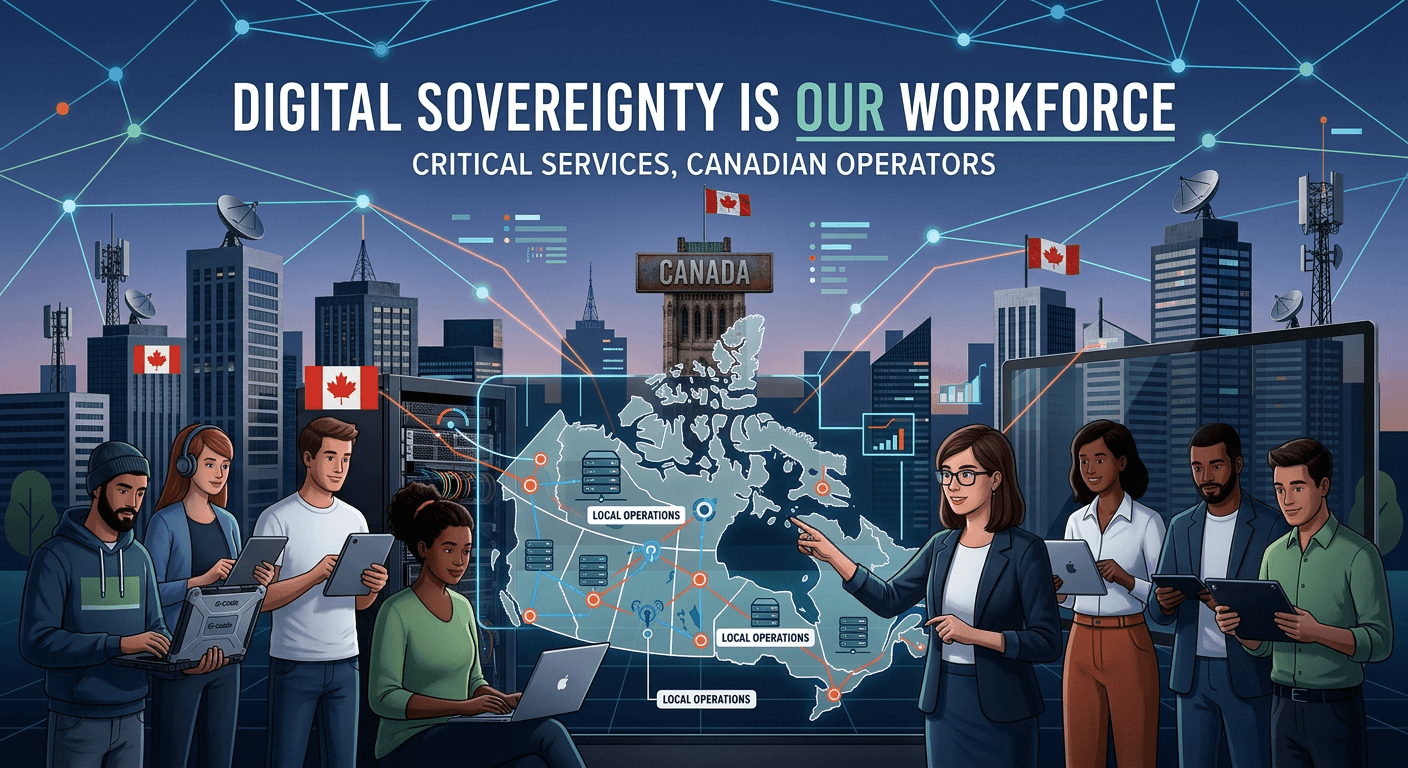
Canada’s conversations around digital sovereignty often focus on infrastructure: cloud platforms, cybersecurity systems, data residency, and critical technology supply chains. Those discussions are important, but they overlook one of the most essential parts of sovereignty itself — the workforce.
Technology systems are only as sovereign as the people operating them.
If critical digital services are delivered primarily through foreign labour, offshore contractors, or external operational dependencies, then sovereignty becomes limited regardless of where servers are physically located.
Building true digital sovereignty requires Canadian-based operational capacity.
The Workforce Problem Behind the Technology Problem
Canada continues to face labour shortages across technology, cybersecurity, digital operations, and compliance-focused industries. At the same time, organizations increasingly rely on outsourced labour models that place operational knowledge and service delivery outside Canadian communities.
This creates several long-term risks:
- reduced domestic workforce capacity
- increased dependence on foreign providers
- operational vulnerabilities
- data jurisdiction concerns
- weakened regional economic participation
The challenge is not simply technological. It is structural.
Canada requires a workforce strategy that develops secure, distributed, Canadian-based labour capable of supporting long-term digital operations domestically.
Why Distributed Workforce Models Matter
Historically, digital employment has concentrated heavily in major urban centres. Rural, northern, and Indigenous communities were often excluded from participation because opportunities required relocation.
Remote operations and distributed work environments are changing that reality.
Today, secure digital work can be performed from geographically distributed communities while remaining centrally governed and operationally coordinated. That creates an opportunity to rethink workforce development entirely.
Distributed workforce models can support:
- cybersecurity operations
- technical support environments
- digital compliance services
- quality assurance
- secure administrative operations
- defence-adjacent service delivery
This creates a more resilient national labour structure while reducing overreliance on centralized urban labour pools.
Indigenous Participation Is Part of National Capacity
Indigenous participation in Canada’s digital economy should not be viewed solely as a social objective. It is also a national capacity issue.
Many Indigenous communities represent untapped workforce potential in regions where traditional economic opportunities remain limited. Employment-first digital workforce development creates pathways for participation without requiring communities to lose people through relocation.
When Indigenous workers are integrated into secure, operationally accountable digital environments:
- communities gain long-term economic participation
- industries gain stable workforce capacity
- Canada strengthens domestic operational resilience
Economic reconciliation and national workforce development are not competing priorities. Increasingly, they are interconnected.
Sovereignty Requires Operational Readiness
A sovereign workforce cannot be built through theoretical training alone.
Operational readiness requires:
- live work environments
- accountability structures
- real production experience
- compliance awareness
- mentorship and supervision
- direct integration into service delivery
This is why employment-first models matter.
Workers develop long-term capability when training is embedded directly into operational systems rather than separated from them.
The objective is not simply to produce graduates. The objective is to produce professionals capable of contributing to real-world digital operations.
The Importance of Keeping Work in Canada
As organizations evaluate cost-saving measures through offshore outsourcing, an important question is often overlooked:
What capacity is Canada losing in the process?
Every outsourced operational function represents:
- experience leaving the domestic labour market
- reduced Canadian workforce development
- fewer opportunities for regional participation
- less operational resilience nationally
Onshore workforce development is not simply an economic preference. In many sectors, it is becoming a strategic necessity.
This is particularly relevant in:
- cybersecurity
- regulated industries
- sensitive administrative services
- public-sector operations
- defence-adjacent environments
Keeping work within Canadian jurisdictions strengthens both economic and operational security.
Building Long-Term Capacity Instead of Short-Term Programs
Digital sovereignty cannot be achieved through temporary workforce initiatives alone. It requires long-term systems designed around continuity, scalability, and measurable employment outcomes.
That includes:
- sustainable training pathways
- employer-integrated workforce models
- regional participation
- secure operational infrastructure
- industry partnerships
- Indigenous-led economic participation
The future of Canada’s digital economy will not be shaped solely by technology platforms. It will be shaped by whether Canada develops the workforce capacity necessary to operate and protect those systems domestically.
Digital sovereignty ultimately depends on people.
And building that workforce must begin now.